SONUSCORE THE ORCHESTRA COMPLETE – EXPAND AND CONQUER
Welcome to Music Nation. This week we are taking a look at Sonuscore’s The Orchestra Complete with the expansion library, Winter Strings. I was very impressed when we reviewed the original release last year and this revamped, expanded and updated edition looks to add much more content and flexibility to the original recipe.
I am excited to get stuck into this review as I loved the original library, rating it one of the best sample libraries of the year. The new Winter Strings expansion looks to add an exciting and unusual angle as well.
OVERVIEW
The Orchestra Complete is an 80-piece orchestral Kontakt-based sample library. This includes over 300 ensemble presets, strings, brass, woodwinds, choir and percussion instruments.
The Orchestra Complete includes everything from The Orchestra original release two years ago, plus 60 extra string articulations, 100 extra patches, ethnic string samples and the new 41-piece Winter Strings orchestra. You can purchase Winter Strings as a stand-alone library if you prefer.
The Orchestra Complete also features the new MIDI-Export feature which allows you to drag and drop all five internal sequence tracks directly into your DAW as MIDI files.
JUST LIKE OLD TIMES
I am a huge fan of Sonuscore libraries; not only do they sound great, but they also have one of the best workflows on the market.
The Orchestra is an all-in-one epic orchestra encapsulating the same easy one-finger workflow from their other titles, making this perfect for those wanting to get up and running quickly with some rather convincing sounding pre-scripted arrangements.

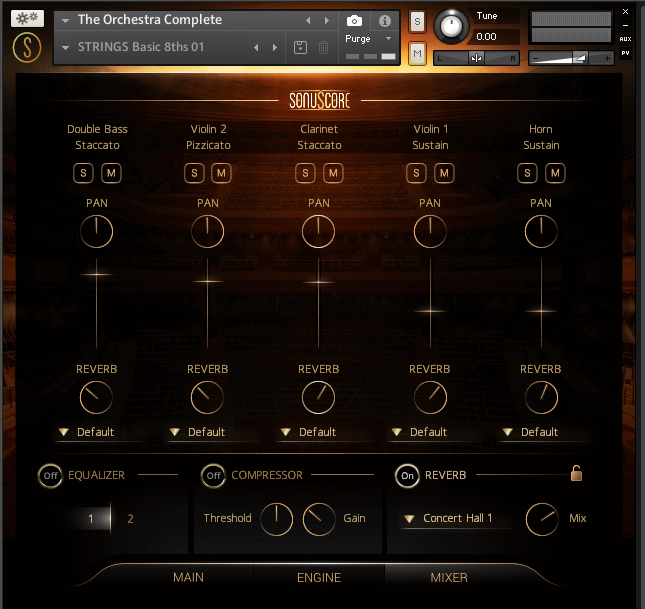
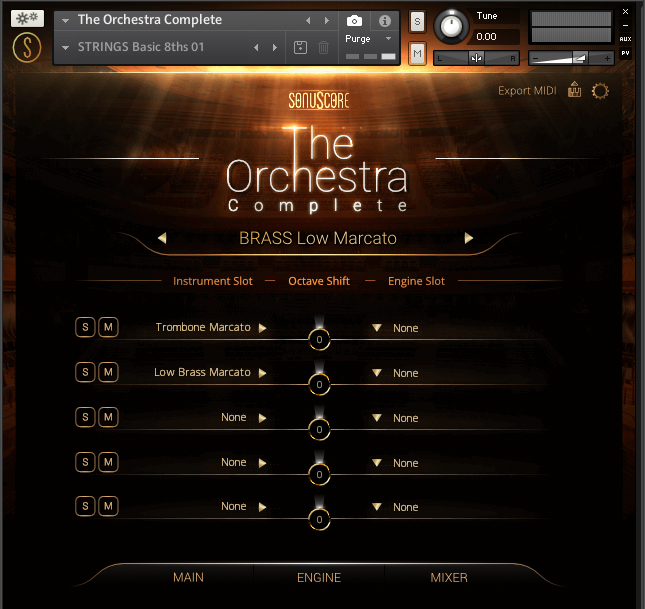
I recommend you to read our earlier review of The Orchestra which covers most of the basic workings of the library. In a nutshell, the core orchestra patch contains five full-independent instrument channels into which you can load any one of the individual instruments as you like.
Each of the five channels includes mixing, panning and effects as you would expect, but most importantly they include access to one of two modulator types available – step arpeggiator or curve envelope.
The step arpeggiator allows you to create up to three unique rhythmic patterns and the envelope allows two unique curves for velocity crescendo-type effects. Together it is possible to create complex arrangements for each instrument in your patch, loading multiple instances to further expand on your creation.
Of course, you can skip the core orchestra patch and opt to load individual instruments much like a traditional orchestral library, though most of the functionality is within this central core patch.
IN WITH THE NEW
There is a rather long list of upgrades and improvements in this new complete edition. Many of them are under the hood and out of sight, but some are quite game-changing.

The entire UI has had a makeover. It looks largely the same at first glance, but when seen side by side with the original Orchestra the new one is much crisper with larger fonts.
The dynamic range of all the samples has been improved with noticeable results. I found much smoother velocity scaling when playing each of the instruments, particularly the woodwind and brass which I felt were a little one-dimensional in the last review.
You can now save and share your core orchestral patches(!). I think this is a fantastic and overlooked feature that could really expand the possibilities of the library. Hopefully, little communities will start popping up to share arrangments and discoveries.
The new Mongolian ethnic Morin Khuur strings are quite interesting to play. Quite a shrill-sounding instrument, they sound similar to Sul Pont strings, with a little more roundness on the low end. It took me a while to place them into an arrangement as the sound is rather jarring against most traditional orchestral instruments. I do not find the staccatos particularly nice as a solo instrument, but they do add extra grit when layered.
The data footprint of these libraries is tiny, making for incredibly fast loading. Even the large multis on our test system all loaded within 5-10 seconds, tops. The new complete edition loads equally as fast as the original, great to see no additional bloat has occurred.
The new MIDI-Export feature is excellent. The idea is for you to record into your DAW a MIDI track, then play that back into The Orchestra. You will notice the MIDI-Export section at the top right of the GUI change to ‘recording’, which means it’s listening to whatever your DAW is sending it.
Once you’ve played the full track, you can simply drag and drop the new MIDI files back into your DAW. In essence, you can convert your one-fingered ideas into a full orchestral arrangement at the click of a button, with all the envelopes and steps arpeggiated intact for further editing.
It’s a very clever feature that is perfect for songwriting. You can put together some rough ideas in your DAW using a piano or whatever your preferred instrument is, then feed that into the Orchestra for a fleshed-out orchestra arrangement.
Of course, this will not be perfect – you will still need to edit the notes and add more embellishments, but the bulk of the heavy lifting has been done by the software giving you a much broader view of your arrangement ready for further editing.
SOUND-OFF
The full string section from the original Orchestra is included with the new Mornin Khuur high and low ensembles. The new high-resolution dynamic range is noticeable, particularly in the extreme ranges (between 120-127 and 0-10 velocities). It’s much easier now to find those sweet spots in the velocity range and hold them.
My only beef with the string section and the library, in general, is the recordings are all quite raw sounding. The library excels at the gritty, epic and bombastic stuff, but is quite difficult to find smooth, delicate sounds.
Of course, one library can’t cover the whole gamut of sound. If you want something quiet, look to Spitfire Audios Albion V. The Orchestra is undoubtedly better off at the big shouty stuff, epic trailers and wall-of-sound Hollywood soundtracks.
The brass features a good range of instruments, but is not comprehensive. The obligatory French Horns are here (for more of that epic wall-of-sound style I mentioned), trumpets, trombone and low brass ensemble. However, the brass section is very raw sounding and quite aggressive. This matches perfectly with the strings, of course. But do not expect anything subtle.
The woodwinds section contains all your usuals – flute, clarinet, oboe, bassoon and contrabassoon. On the whole, all sounded very nice, with none of the brass and string overkill. The oboe, in particular, is wonderful sounding, even with its minimal dynamic control.
The percussion section is small but adequately useful. There is a nice-sounding Glockenspiel and harp I found good to play, and a selection of orchestral percussion, timpani and tubular bells all sound great.
The choir section is surprisingly good. Though no detailed vows or word-building capabilities are present, the basic oh’s and ah’s with a selection of staccato hits are all quite nice. My only wish is for an ADSR envelope as some more flexibility on the note lengths could be useful.
The String FX section contains a useful selection of hits, falls and obligatory risers patches all orchestral libraries seem to have these days. Happily, these are all organic orchestral effects, not synthesised emulations. The sound of the full tutti orchestra performing a slow riser is amazing and quite scary sounding – perfect for spooking the neighbours!
CONCLUSION
I really cannot find any serious faults with The Orchestra Complete. The additional benefits this new edition brings to the table enhance the flexibility of the original in a number of important ways to make the upgrade almost required buying.
While the library suffers a little from being overly bombastic, in my opinion, some will instantly love this hyped style. I think it is probably better to have too much, as you can always pull things back. But the sound is certainly more epic and shouty than your typical orchestral affair.
This, however, does make the library feel to me quite big. Bringing a bazooka to a knife fight comes to mind. It’s a real bull to wrangle for anything subtle, but let it loose and it will quite happily destroy the china shop.
I commented on the original Orchestra review on how quick and easy scoring with the library was, and nothing has changed. This is by far the best tool to have open when brainstorming ideas. I love the multi-patches for instant gratification, and the individual instruments are now even better sounding than before.
The MIDI-Export is genius and completely indispensable now for curating ideas. This has rescued me a number of times from frustrations in scoring lines, acting much like a second composer in the room. I would most definitely say it is worth the price of the upgrade just for this feature.
A wonderful library for both novice and professional composers. Top-notch sound, flexible instrument selection and innovative features. Has Sonuscore surpassed itself again? Undoubtedly yes.
Highly recommended.
For full details, purchasing and upgrade options visit Best Service www.bestservice.com

Like the review? Shout us a cup of coffee!